
Volume 9, June 2026
Key Points
- Local prosperity is influenced by neighboring regions: factors that enhance the prosperity of one place can have positive spillover effects.
- When communities work in partnership with their neighbors, they can collaborate on meeting the shared needs of residents.
- While communities can leverage their proximity to one another, proximity alone cannot drive prosperity.
Is rural livability all that rural?
Those who live and work in rural Wisconsin often champion the attributes that make rural different from their view of big cities. In fact, there is a certain degree of pride in positioning rural as distinctly separate from urban. Yet, we know from an economic perspective that rural and urban places are intertwined: inputs to many urban businesses are supplied by firms in rural areas, rural residents often shop in nearby urban areas, and commuting often ties rural workers to urban employment centers as well as urban workers to rural communities through reverse commuting. This interconnectedness not only blurs the line between rural and urban, but it also has implications for community economic development, especially in rural contexts.
More and more communities are focusing their community economic development efforts on the ability to support health and safety, social connectivity, and the everyday needs of residents – a condition we refer to as “livability.” Compared to the era where employment and growth opportunities were the dominant drivers of mobility, today livability is becoming the currency with which places compete for people, jobs, and recognition.i
Pursuing the features, resources, and amenities that contribute to livability can sometimes put communities in competition with one another. Neighboring small towns may be vying for the same growth and development opportunities, whether those be businesses or residents. This can lead to secondary competition for resources such as public spending on infrastructure, recreational amenities, and schools. In this setting, more investment in one place could be perceived as less for another. Some communities can be viewed as getting more than their “fair” share, leading to rural-urban resentment.ii
This adversarial framework is further exacerbated by decades of economic development research that emphasized rural, geographically peripheral places as dependent on “core” urban regions to offer critical services that maintain regional economies. Rural residents may travel to their nearest urban area for amenities that require a larger population base to support, such as specialized healthcare services, retail experiences, or large-scale entertainment venues. Some rural residents may also rely on proximate urban areas for employment opportunities otherwise unavailable closer to home. Following this logic, rural places are therefore dependent on proximate urban places to sustain their economies and livelihoods. Further, rural areas are likely to have an economic advantage of being located near a successful urban area.
Modern economic development theory has largely moved beyond this one-directional view of regional economic development, instead acknowledging the ways rural and urban economies mutually intersect through, for example, shared food systems, energy infrastructures, as well as environmental amenities and challenges.iii This perspective is especially critical today given most rural people live near urban places,iv reinforcing the relevance of economic, social, and cultural interdependencies across the urban-rural interface.
While what characterizes rural is distinct, for most rural residents, the livability of their community is shaped (at least in part) by nearby cities – often small and mid-sized. In turn, the lived experience of urban places is also influenced by the surrounding rural context.
In this WIndicator, we 1) document the statistical relationship between the prosperity of neighboring urban and rural places and 2) explore the role of population density and distance as dimensions of shared prosperity. In doing so, we further examine the interdependencies between rural and urban places as factors driving prosperity. Our conclusions call for greater consideration of regional dynamics in policies aimed at enhancing local prosperity conditions.
What makes a place livable?
Livability is the combination of observable and non-observable factors that make a place somewhere people want to, and can easily, live. The concept of livability is widely researched, though it is sometimes operationalized using different terms, such as quality of life, well-being, vitality, or – as we have in a related WIndicator – prosperity. The wide range of terminology is reflective of a concept that is highly subjective and difficult to measure.
Unlike approaches to calculating economic well-being where researchers can look at a set of concrete indicators like GDP, employment, number of businesses, and the like, livability is more difficult to grasp because it includes both economic and hard-to-measure, non-economic factors. That is, the reasons why people like the places they live extend beyond just the economic context. For example: Can your children get a good education? Is your housing situation safe and comfortable? Do you identify with your community, and can you find social connection?
There are a number of ways researchers measure livability, including some we explore on our website: rurallivability.org. For this WIndicator, we measure livability using a related “prosperity” measure defined as the combined performance across four indicators: poverty, unemployment, education (high school dropout rate), and housing (substandard conditions in relative cost, crowdedness, plumbing, and kitchen facilities).v In what follows, we use this measure to consider how prosperity is shared across the urban-rural interface.
Where is livability?
Urban places have the population and economic base needed to more easily sustain key institutions that provide cultural experiences, economic diversity, and resources that enhance livability. In contrast, rural places can struggle to maintain a population and economic base that facilitates the capacity to support those same factors. But, rural places may draw from proximate urban places to support livability and vice versa. Urban places benefit from nearby rural assets in a way that can make them nicer places to live. In this WIndicator, we ask: To what extent are urban and rural prosperity correlated? In other words, can we find evidence of shared prosperity across the rural and urban continuum?
The answers to these questions are critical for motivating how policymakers and practitioners approach livability strategies. If it is the case that rural prosperity and urban prosperity are linked, rural and urban communities can work together on regional strategies that benefit both. If, however, prosperity is locationally specific, this offers evidence to encourage isolated approaches and to tailor programmatic support designed specifically for the rurality of a community.
Instead, we find the relationship is more complex. We use the prosperity measure to show rural and urban prosperity are indeed shared regionally, but the relationship between them depends on the context. From a rural perspective, rural prosperity is associated, to varying degrees, with proximate urban prosperity, but proximity to urban places does not and cannot explain all of rural prosperity no matter how attractive the urban area may be. This suggests that the experiences and resources that urban places can offer do also enrich the livability of surrounding rural areas, but rural places benefit from a foundation for local livability. Rural livability is not entirely derived from their urban neighbors, but they should consider what their neighbors have to offer to be additive and complementary rather than duplicative and competitive.
A National Perspective
To give context to the relationship between urban and rural prosperity, we first consider trends found by using county-level data for the U.S. In our national analysis, we find evidence to suggest a positive association between the prosperity of an urban center and the prosperity of the surrounding rural places.1 In fact, for every increase in urban prosperity we can expect on average a positive boost to prosperity in surrounding non-urban counties.2 This relationship changes in magnitude and direction when the distance between and level of urban prosperity is taken into account. Through our analysis we find that:
- Rural counties closest to urban counties have higher levels of prosperity, compared to those farther away. This means among the rural counties, those closest to urban areas have a prosperity “advantage.”
- Distance is less relevant for remote rural counties. This means that the further an urban area is from a given county, the less influence that an urban area has on local prosperity.
These findings are intuitive, suggesting that distance matters, but only up to a certain point. Increased distance, especially for remote places, reduces accessibility making the resources and amenities available in neighboring places less usable in the everyday lives of residents. Jobs in an urban center are less relevant to those in distant small towns than those in nearer suburban communities. Similarly, affordable housing opportunities in rural places are less relevant to residents of a faraway city than those only a short drive away.
One way to think about the shared relationship is to focus analysis on the prosperity of the large urban “anchor” community as a hub for jobs, businesses, and people. Intuitively, again, we find that for rural communities, distance to the nearest urban county interacts with prosperity differently depending on the prosperity of their nearest urban neighbor. Among urban counties with the lowest scores of measured prosperity, the prosperity of surrounding rural counties improves with distance from these urban centers (Figure 1a). Among urban counties with the highest rates of measured prosperity, the prosperity of rural counties declines with distance (Figure 1b).
Figure 1. Average rural prosperity scores by distance in miles to nearest (a.) “lowest” and (b.) “highest” performing urban counties
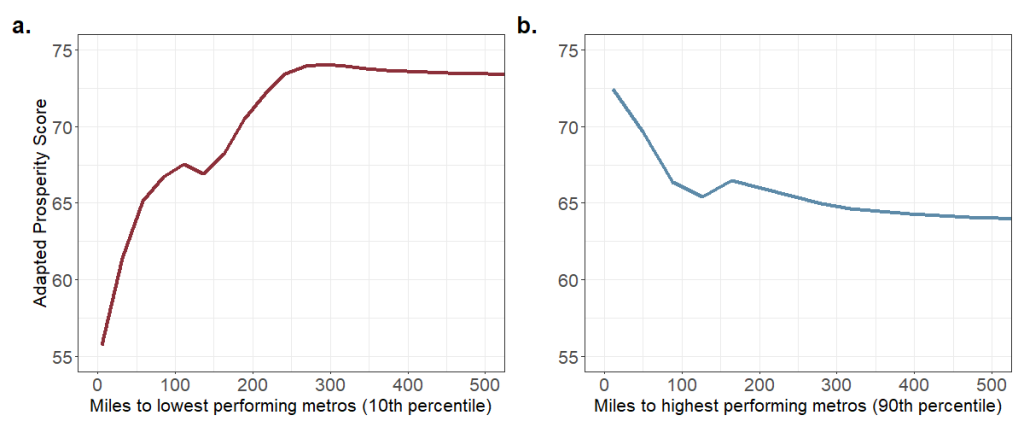
Thus, interdependencies between rural and urban places matter for livability, but how those interdependencies manifest varies in direction and degree. A geographically informed understanding of livability recognizes the ways in which livability is influenced by all the areas around it – rural and urban alike.
As a practical takeaway, rural communities in close proximity to urban areas should consider the livability conditions of their nearby city when investing in the livability of their own community. For example, if community leaders conduct asset mapping to evaluate the livability of their community, they should also assess what is available and accessible to their residents in nearby cities. As one would expect, more remote rural communities, however, may not be as influenced by their neighboring cities’ conditions, as their residents’ ability to access urban amenities is more limited. Thus, the experiences and resources of the nearest urban center are likely to be less impactful in an asset mapping exercise.
A Wisconsin Perspective
Next, we narrow our focus to Wisconsin and create a new prosperity measure using Census tracts. Census tracts are sub-county geographical units often used for population and economic analysis. A sub-county analysis using Census tracts is one way to guard against oversimplifying the complex rural-urban continuum that exists within counties. For example, Vernon County, Wisconsin as a whole is classified as nonmetropolitan, but within-county variation exists. Sub-county Census tract classifications within Vernon County extend across the rural-urban continuum, including rural, small town, and urban areas. Even the most urban counties in the state like Dane, Racine, and Kenosha Counties include rural sub-county designations.
In addition to representing a smaller geographic area and fewer residents than counties, tract boundaries also typically follow real-world boundaries like roads or rivers, making them a more practical unit of analysis for considering how people move across space.3 They vary in geographic size because they are designed around population with the Census targeting ~4,000 people per tract. This typically results in very small urban tracts and much larger rural tracts.
For every Census tract in Wisconsin, we compare the rate of each of the four prosperity indicators (i.e., poverty, unemployment, education, housing) to the state average and subtract the difference. We then sum across the four indicators to produce a prosperity index. The higher in value the index ranking, the higher the prosperity – by this measure. Likewise, the lower the index ranking, the lower the measurable prosperity.
The tract-level prosperity index for Wisconsin using 5-year census estimates from 2019-2023 is mapped in Figure 2a. There are clear geographic patterns with evidence of prosperity clusters around the state. That is, we find some regions that fare better (or worse) on this measure of livability than others.
Figure 2: Prosperity in Wisconsin, 2019-2023
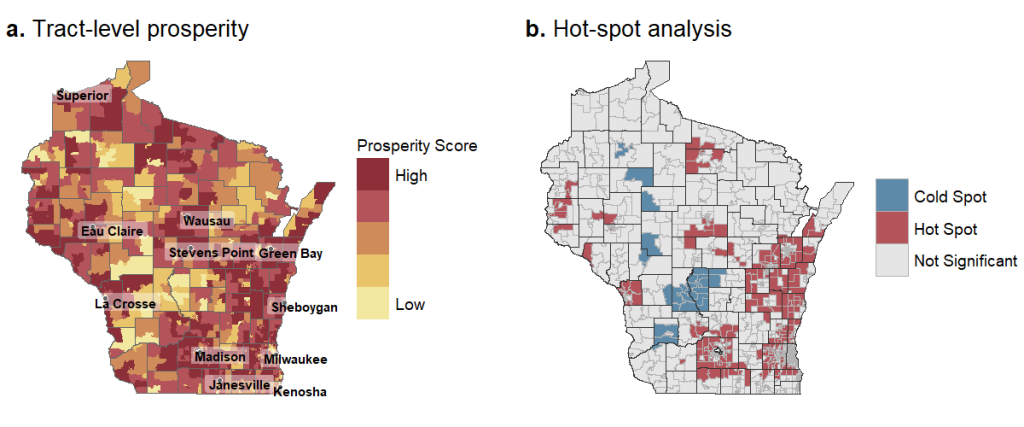
In Figure 2b, we statistically identify these clusters by comparing nearby places to each other. The resulting “hot” or “cold” spots are places where high or low values of the prosperity index tend to cluster together more than we would expect by chance. The Milwaukee, Madison, Green Bay, and La Crosse suburbs are notable “hot spots,” though importantly, the urban cores are not included. Rhinelander also fares well. “Cold spots” include a prominent cluster in Adams, Juneau, and Waushara Counties. Jackson and Clark Counties, Richland County, and Rusk and Taylor Counties also have exhibit prosperity “cold spots.”
How does livability vary by rurality in Wisconsin?
Despite being highly subjective and difficult to measure, nearly every measure exposes how livability exhibits spatial dimensions, especially across the urban-rural interface. That is to say rural and urban livability are distinct.
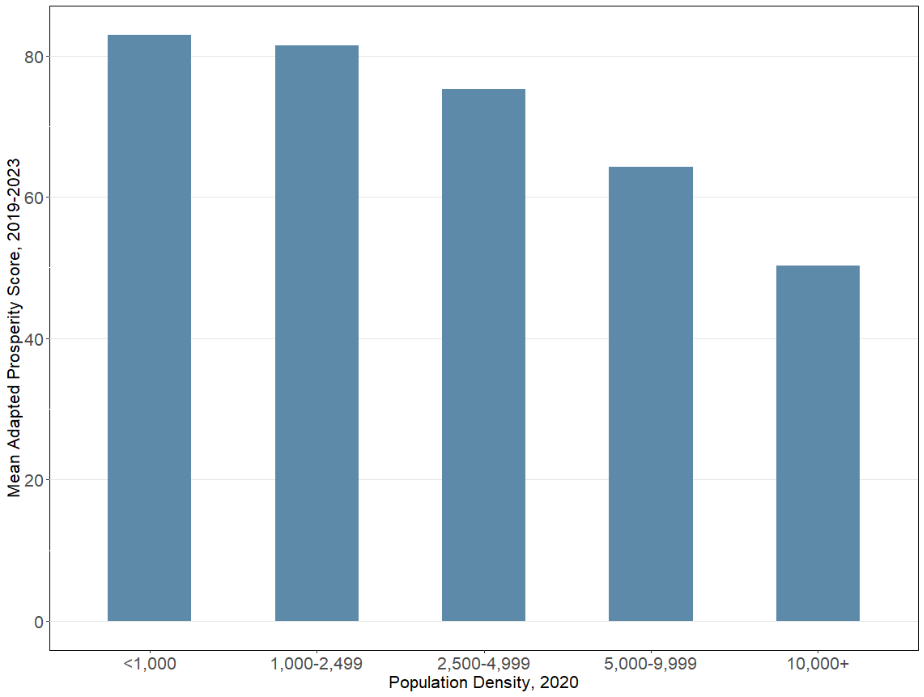
Using the place prosperity measure, we find that in Wisconsin, prosperity typically decreases with increased population density (Figure 3). This means that in general, more rural places in Wisconsin have better-than-average rates across more of the four indicators than urban places.
Figure 3. Wisconsin Census tract Prosperity by Population Density where population density is the number of people per square mile
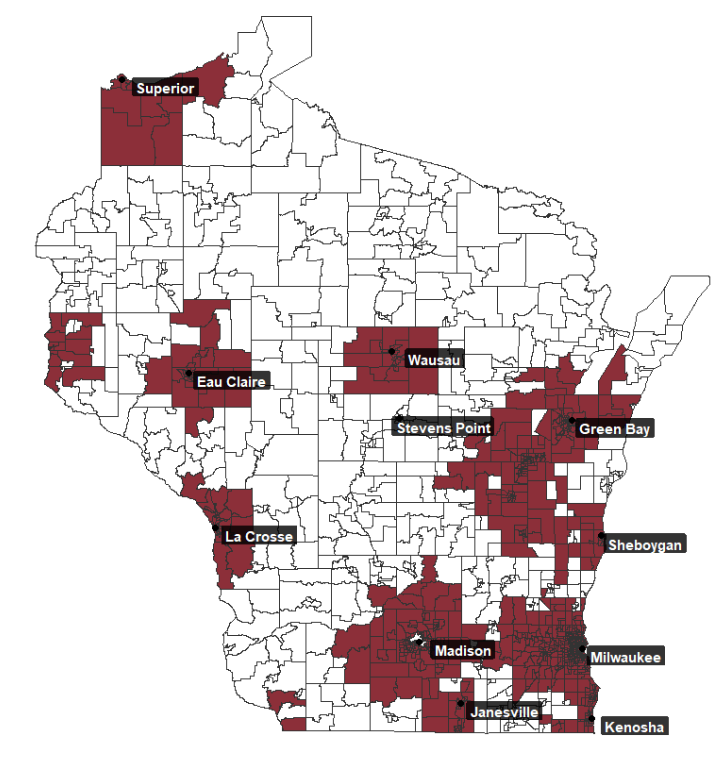
While prosperity is measured based on the outcomes within a single Census tract, it cannot be ignored that they exist in a spatial context: rural places are located within some degree of proximity to non-rural places, and vice versa. In Figure 4, we show the Census tracts in Wisconsin that are considered urban in red.4 While some rural tracts may be further from an urban area, others are much closer.
Figure 4. Metropolitan (“Urban”) Census Tracts
Again, from the perspective of rural communities, we find that rural communities and small towns closest to urban areas – of any prosperity level – fare better, though only slightly, than those further away (Figure 5a).5 But, among these rural places, those near prosperous urban areas fare even better (Figure 5b).
These findings are consistent with emerging research showing structural economic changes via processes like globalization and automation have concentrated economic opportunity in urban places.6 Given the economic and social linkages between nearby places, it is intuitive that rural places near urban places would do better than those that are not. Yet, what Figure 5a and 5b suggest is that the consequences are not just economic; there are broader impacts on regional livability.
Figure 5a. Average Prosperity Score of Wisconsin rural and small-town tracts by distance to nearest urban Census tract, 2019-2023
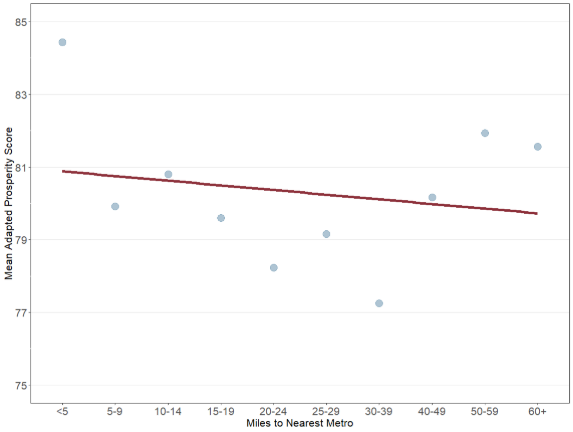
Figure 5b. Average Prosperity Score of Wisconsin rural and small-town Census tracts by prosperity of nearest urban Census tract, 2019-2023
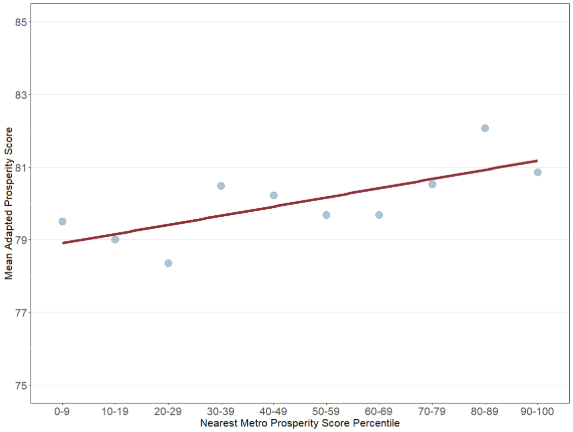
Taken together, these findings pose a bit of a contradiction: the least densely populated areas have the highest prosperity score, but rural places benefit from proximity to urban places – especially when those urban places are also prosperous. What this suggests for rural communities are livability “tradeoffs” between size and distance to urban areas. Communities with sparser population density are more prosperous than their denser counterparts, and small communities near prosperous urban areas are even more so, but prosperity decreases as the urban area gets closer. As such, rural communities may feel tension between being close to an urban area (which boosts prosperity scores) and population growth (which tends to correspond to lower prosperity scores).
Some caution in interpretation is warranted, however. The distribution of prosperity score by distance to urban tracts is highly variable, and these analyses only reflect an average that may not be representative of all communities.
What can we say about the relationship between the livability of rural and non-rural places?
National and Wisconsin-specific findings demonstrate that the prosperity of our neighbors does “matter” for one’s own local prosperity, even, and perhaps especially, when those neighbors are at different points along the rural–urban continuum. How much it matters changes by distance. We also find that it changes depending on the prosperity of the nearby urban place. These relationships are bi-directional: rural livability matters for urban livability, and urban for rural too.
We identify three implications for rural places that face challenges of population, employment, and institutional decline.
First, rural communities and small towns should be careful not to discount the influence of urban proximity on livability but cannot rely on proximity alone to drive livability. For better or worse, the livability of neighboring communities matters for local livability. Abundant regional amenities can enrich the lived experience of residents in rural communities and small towns, but a lack of regional resources demands communities develop these amenities locally to ensure adequate services for their residents. Thus, communities should carefully consider how their geographic position may affect livability conditions locally.
Second, approaches to enhancing livability ought to be regionally informed while maintaining local specificity. Uniform approaches are likely to miss the mark when applied to the unique conditions of rural (or urban) places. On the other hand, hyper-local approaches that isolate communities as purely independent entities ignore the actual lived experiences of people who regularly traverse the urban-rural interface.
Third, place-based investments into community livability can be divisive, but these investments are likely to benefit a broader region of rural and urban communities alike. Community economic development investments are sometimes perceived as zero-sum games: dollars are either spent to improve rural or urban places, not both. Our findings suggest instead that place-based investments can be mutually beneficial and enhance a whole region. We benefit when our neighboring communities – whether urban or rural – do better, too.
Rural livability does not exist in a vacuum; it is influenced by a myriad of factors, some of which are in local control and some of which are not. Better understanding how rural livability intersects with urban livability offers practitioners a different perspective on how to improve the quality of life in their own communities by thinking about where they are situated in a broader regional landscape.
Policy Implications
- Rural communities should continue to invest in livability, whether that be supporting small business development, improving educational attainment and school quality, or ensuring residents have adequate employment opportunities.
- The livability of rural communities does not happen in isolation. Rather than only taking a hyper-local perspective, leaders must consider their community in the broader regional context. What do residents have access to in their own community and what can they access in nearby places? What gaps exist? What sorts of resources and amenities are available elsewhere, but would be better if offered locally? Or, on the other hand, what can residents borrow from other (perhaps more densely populated) communities to make up for what is infeasible to provide locally? While the answers to these questions may be more applicable to rural communities closest to urban centers, it remains critical for all communities to keep their neighbors in mind when working towards enhancing livability.
- Enhancing livability is a continuous process. As needs and desires evolve and the availability of amenities and resources locally and regionally change, communities must also reassess and adapt. Local leaders and collaborative partners nearby will be helpful in ensuring long-term rural livability.
Suggested Citation
Schmidt-Larios, D., Boyce, M., Conroy, T., & Deller, S. (2026). WIndicator: “Sharing Livability: Assessing the Link Between Rural and Urban Prosperity” [Technical report]. University of Wisconsin–Madison Division of Extension. https://doi.org/10.21231/mwem-5533
Acknowledgements
Our thanks to Yang Cheng, Erin Kenney, and Andrew Van Leuven for their helpful comments.
Funding Statement
Financial support for the research, authorship, and publication of this article comes from the Wisconsin Rural Partnership Initiative at the University of Wisconsin-Madison, part of the USDA-funded Institute for Rural Partnerships. Any opinions, findings, conclusions, or recommendations expressed in this publication are those of the authors and do not necessarily reflect the view of the United States Department of Agriculture.
Nondiscrimination Statement
The University of Wisconsin-Madison Division of Extension provides equal opportunities in employment and programming in compliance with state and federal law. / La División de Extensión de la Universidad de Wisconsin–Madison ofrece igualdad de oportunidades en el empleo y en sus programas, en cumplimiento con las leyes estatales y federales. / University of Wisconsin–Madison Division of Extension muab kev sib npaug rau kev ua haujlwm thiab kev kawm raws li lub xeev thiab tsoomfwv txoj cai.
References and Further Reading
i | Deller, Steven. 2025. “Are We at an Inflection Point in Community Economic Development? The 4th Wave.” Economic Development Quarterly 39 (4): 215–31. https://doi.org/10.1177/08912424251339139.
Notes
1 | For our analysis, all counties classified as metropolitan are referred to as urban, and all nonmetro counties are referred to as rural. This method of distinguishing between rural and urban is widely used in both research and policy contexts.
2 | A 1-point increase in urban prosperity score is associated with a sizable 0.422-point average increase in surrounding non-urban counties’ prosperity score.
3 | Census tracks seldom coincide with municipal boundaries.
4 | Classified as Rural-Urban Commuting Areas (RUCA) 1-3.
5 | Rural and small towns are classified as Rural-Urban Commuting Areas (RUCA) 7-10.
6 | For more, see the following report from the Center for Rural Innovation: https://ruralinnovation.us/blog/equity-economic-opportunity-rural-america/