

Home » RESET: Renewable Energy Siting & Engagement for Tomorrow » Solar Leasing Contracts
Solar Leasing Contracts
RESET: Engaging Wisconsin Communities in Renewable Energy
Solar Leasing Contracts
Learn about Solar Leasing Contracts
Interest in renewable energy is growing across Wisconsin as the state aims to replace energy from fossil fuels like coal and natural gas with wind and solar. Wisconsin farmers and rural landowners have the opportunity to lease their land for solar developments.
Land leasing for solar projects can provide guaranteed income, but there are important items to consider when negotiating with a solar developer. What could a future under a solar lease look like for a landowner?
The guide and resources on this webpage can help you effectively partner with an attorney to secure an agreement with a developer that protects your interests. This is not a substitute for hiring legal counsel.
Information about Solar Leasing for Landowners
This UW-Madison Extension guide covers important items for landowners to think about when considering leasing, or negotiating with a solar developer. Download our land leasing guide for a thorough overview of solar leasing norms in Wisconsin, including common contractual terms and conditions included in a solar lease agreements. Topics include:
- Who is the developer, what is their track record, and do their goals align with your vision for the land?
- How long is the term of the agreement, and can it be terminated early?
- How much is the developer offering to pay during the permitting, construction, and operational phases?
- What is the payment structure? Is that in line with average leasing payments?
- Additional items to consider include legal liability, tax implications, and local regulations.
Conversations with Solar Developers: A Companion Worksheet
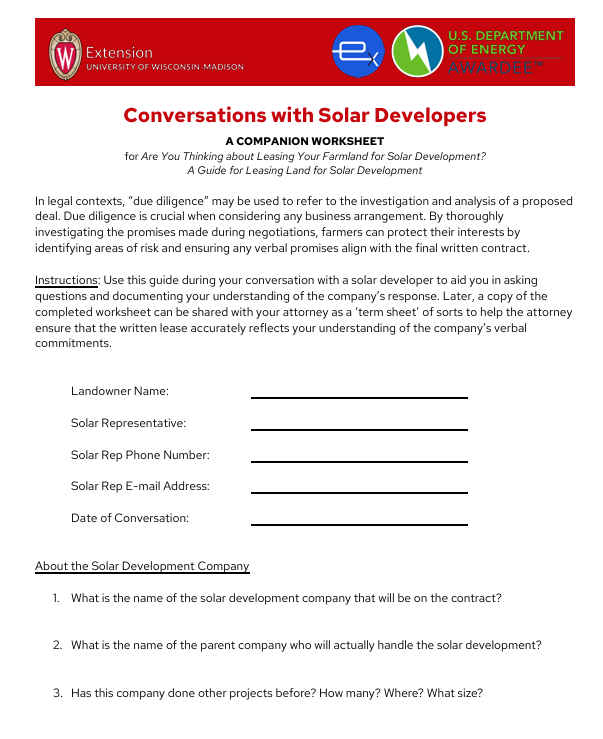
This worksheet has the questions from the solar land leasing guide, and is for landowners considering leasing their land for large-scale solar developments.
This worksheet can help document important information and questions about proposed projects during conversations with solar developers or others.
This information will be useful to provide to your attorney when reviewing lease agreements provided by developers.
Frequently Asked Questions
Disclaimer: This is not legal advice. Consult a qualified attorney for guidance.
Leasing land for solar can be financially beneficial, but it’s important to research, ask questions, and negotiate terms that protect your interests.
Tips for Negotiating a Solar Lease
- Know the details – Developers write contracts that favor them, so be prepared.
- Get expert advice – Solar leases can be complex; consult an experienced attorney.
- Do your homework – Understanding the contract helps you protect your interests and get the best deal.
Leasing Your Land for Solar—Key Steps
When considering leasing your land for solar development, vet the solar developers thoroughly.
- Research the developer – Understand their history, experience, and goals.
- Verify promises – Ensure all commitments are in writing.
- Communicate – Discuss expectations, neighbors, and local impacts.
- Negotiate wisely – Avoid pressure tactics and take your time.
- Get everything in writing – Protect yourself with clear agreements.
Choosing a reputable developer with transparent terms helps reduce risk.
What Land Do Developers Look For?
Before signing a lease for solar development, consider these points:
- Location: Near roads and transmission facilities, but away from prime farmland or future building sites.
- Future Plans: Ensure it won’t disrupt your long-term farm goals.
- Construction Impact: Consider how building affects operations and check local regulations.
- Property Details: Verify exact fields and acreage in the lease.
- Obligations: Check if adjacent properties are affected and confirm compensation.
Thinking through these points will help you make the best decision.
Solar Lease Earnings—What to Expect
- Rates: Typically $500-$1,500 per acre per year in Wisconsin after construction.
- Payment Structure: Flat per acre, based on power production, or a mix of both.
- Inflation Adjustments: Some leases allow rent to increase over time.
- Lease Length: Usually 15-25 years, often with automatic renewals.
Things to Consider:
- Payment Schedule: When and how often will payments arrive?
- Due Diligence: How long before payments begin while the land is assessed?
- Income Stability: Do you prefer fixed income or a variable rate based on production?
Understanding these factors helps you make the best choice.
Solar Lease Length & Approval Process
- Lease Term: Usually 15-25 years, often with automatic renewals.
- Termination: Developers may end leases at any time—ask about past terminations.
- Project Approvals:
- MISO oversees Wisconsin’s transmission system and approves interconnections.
- PSC permits solar projects 100 MW or larger.
Lease Termination & End of Lease Questions
- Can the developer end the lease anytime? Ask if they’ve done this before and why.
- Can you end the lease early? Understand the terms.
- Will the land be restored? Confirm what’s included in the agreement.
- What happens if the developer sells or goes bankrupt? Ensure decommissioning plans are clear.
For a detailed list of lease provisions, check Are You Thinking About Leasing Your Farmland for Solar Development?
How does regulatory approval work for large-scale renewable projects?
Regulatory Approval & Lease Terms
- Approval Process:
- MISO oversees Wisconsin’s transmission system and approves interconnections.
- PSC permits solar projects 100 MW or larger.
- Ending the Lease: Can the landowner terminate early? Check the agreement for terms.
- End of Lease:
- Restoration: Will the developer return the land to its original condition?
- Decommissioning: If the developer sells or goes bankrupt, who handles removal?
For more details, read Are You Thinking About Leasing Your Farmland for Solar Development?
Key Terms in a Solar Lease Agreement
- Land Option – Developers may request an exclusive right to lease or buy the land, even if they don’t plan to build immediately.
- Leased Premises – The contract should include a legal description of the land being leased.
- Lease Term – Typically 15–25 years, with automatic renewal periods afterward.
- Rent – Usually a dollars-per-acre rate, which may change during renewal periods or include specific payment schedules.
- Site Improvements – Covers construction plans, signage, fencing, and utility easements required for the solar array.
- Access Rights – Includes developer’s ingress, egress, and utility easements for building and maintaining the solar project.
- Maintenance & Security – Typically, the developer is responsible for both.
- Landowner Guarantees – Landowners ensure the leased land is free of liens or restrictions that could affect the solar array.
- Title to Infrastructure – The solar company retains ownership of site improvements until the lease ends and must repair any damage.
- Allowed Uses – The lease should specify that solar development is the primary activity allowed on the land.
- Mortgage & Property Rights – The lease may be subordinate to existing mortgages, affecting property sales.
- Leasehold Mortgages – Defines protections for lenders who finance solar development.
- Permits & Compliance – The solar company must obtain government approvals and may require landowner cooperation.
- Assignment Rights – The developer may transfer the lease; landowners should consider future property sales when reviewing terms.
- Official Notices – The contract should require written notices sent to designated addresses.
- Insurance – Developers must carry commercial liability coverage (often at least $1 million).
- Operating Expenses – Developers pay for energy and water used on the site.
- Taxes – Landowners pay property taxes, but developers cover tax increases linked to the solar facility.
- Landowner Maintenance – Landowners may need to maintain adjacent land and keep it free of obstructions.
- Liability to Third Parties – Both parties agree to hold each other harmless for injuries caused by their actions.
- Indemnification – Covers reimbursement for damages caused by negligence or misconduct during construction or operations.
- Liability Waiver – Landowners may have to waive rights related to risks like noise, glare, or drainage changes.
- Tenant Responsibilities – Developers must pay rent and return the land at the end of the lease.
- Default & Termination – Defines what counts as a default and the rights of each party if a breach occurs.
- Early Termination – Developers can exit if the site proves unsuitable, with advance notice (usually 30 days).
- End-of-Lease Cleanup – The contract should state who removes the solar equipment when the lease ends.
- Binding on Future Owners – The lease stays valid even if the land or company is sold.
- Developer Access – Grants entry rights for contractors and employees.
- Governing Law – Landowners should ensure the lease is governed by Wisconsin law and disputes go through local courts.
- Entire Agreement Clause – Verbal agreements aren’t valid unless written into the contract.
- Survey & Testing Rights – Developers may conduct soil and environmental tests before leasing.
- Mineral Rights – Landowners keep rights to oil, gas, and minerals, but drilling may be restricted.
- Hazardous Waste – Developers must take responsibility for any contamination they cause.
- Liens & Construction Costs – Developers must prevent contractors from placing liens on the leased land.
Before signing, work with an experienced attorney to ensure the lease meets your needs!
Farming & Solar Leases
Beyond the basics, landowners often ask about key topics that can impact their agreements. These details matter, so make sure your lease clearly spells out rights and responsibilities. Here are a few important areas to explore:
- Farm Use During Development – If the project is delayed, can you still farm the land? Make sure the lease clarifies temporary agricultural use during the early phases.
- Farm Use After Installation – Once panels are up, can you cut hay, graze livestock, or spread manure? Sheep and goats can help maintain the land under solar arrays.
- Liability Concerns – Dust, chemicals, and runoff from farming could affect solar panels. Check if the lease addresses liability for these issues.
- Agrivoltaics – Some farmers turn leased land into pasture for livestock, if allowed. Research continues on dual-use solar and agriculture practices.
- Crop Damage Payments – If farming continues, the lease may cover losses from construction or operations. Review payment terms carefully—how yield is measured, reimbursement rates, and timing.
- Timing Matters – If farming must stop, when will it happen? A December vs. May stop date could significantly impact operations and payments.
Written Agreements Are Key – Farming under a solar lease is possible but must be clearly defined in the contract to be enforceable.
Farm Lease & Solar Lease—Know Your Rights
If you rent land to a farmer and sign a solar lease, make sure you understand both agreements. Some solar developers may require farming to stop—coordinate this with legally required lease termination notice for the farmer.
Learn more about ending a farmland lease in Wisconsin in this Farmland Lease Termination Guide.
Farmland Preservation & Solar Leasing
If your land is in the Farmland Preservation Program, check with the Wisconsin Department of Agriculture, Trade & Consumer Protection to see if it’s eligible for solar leasing.
Learn more: Farmland Preservation Program.
Check Land Restrictions Before Signing
Make sure easements, mortgages, or liens won’t limit your solar lease. An attorney or title company can help review and manage any restrictions.
Solar Site Property Maintenance—Know Your Rights
Solar Site Maintenance—Know Your Responsibilities
Who handles upkeep under the panels? If it’s you, check if you’re compensated and allowed to use herbicides. If it’s someone else, confirm access and management details.
For substations or transmission lines, Wisconsin law requires utilities to control weeds, but developers may ask you to waive this right. Review your lease carefully.
Learn more: Landowner Rights in Wisconsin.
Drainage Tile—Protect Your Land
If your land has drainage tile, make sure your agreement states the solar developer is responsible for repairs, access, and reimbursement. They should also cover any flooding until the tile is fixed.
Signing Bonus & Attorney Fees—Know the Terms
Does the lease offer a signing bonus? Check for a time limit—it shouldn’t pressure you to sign too quickly.Some developers cover attorney fees for lease review. Be sure you can pick your own lawyer, preferably one experienced in solar leases.
Access Rights—Plan Ahead
Make sure your lease includes right of entry if you need to access other land you own or rent—especially if farm lanes run through the leased area.
Local Regulations—Check Compliance
Ensure the solar array meets county and town zoning rules. Confirm access road approvals and understand any cooperation required for permits.
The Wisconsin DNR highlights key concerns like wetlands, erosion, invasive species, and end-of-life disposal. Learn more: Wisconsin DNR Solar Guidelines.
Insurance—Clarify Coverage
Who covers liability insurance? If the developer provides it, ensure you’re listed as an additional insured. If you need coverage too, expect them to request the same.
Confidentiality—Know the Terms
Does the agreement have a confidentiality clause? If so, check how it affects you, your family, and employees—plus any penalties for non-compliance.
Decommissioning—Plan for the Future
When the lease ends, who removes the solar array and restores the land? Consider buried lines, future development, and who pays if the developer sells or goes bankrupt.Landowners may require escrow funds or a removal bond to ensure restoration costs are covered.
Eminent Domain & Solar Projects
Wisconsin law lets utilities use eminent domain for power plants and transmission lines, but it’s unclear for non-utilities. Experts argue solar projects don’t need eminent domain since land assembly isn’t a big hurdle.
So far, no eminent domain actions for solar generation have been initiated in Wisconsin.
Property Taxes & Solar—Know the Impact
Farmland may get use value assessment, lowering taxes. If converted to solar, taxes could rise if the land is reclassified.
Solar panels and storage may be tax-exempt, but the land itself might not be. Utilities may pay a license fee instead of property taxes.
If land is rezoned, a conversion penalty may apply. Discuss with the developer whether they’ll cover tax increases or penalties.Learn more: Wisconsin Agricultural Assessment.

RESET: Engaging Wisconsin Communities in Renewable Energy
Contact RESET:
3500 University Avenue, Madison Wisconsin, 53705