

Home » RESET: Renewable Energy Siting & Engagement for Tomorrow » Agrivoltaics
Agrivoltaics

Agrivoltaics?
Agrivoltaics [ag-ri-vol-TAY-iks] is the practice of using land for both solar energy production and agriculture, such as grazing livestock or growing crops around solar panels. It is sometimes also referred to as dual use solar. By combining renewable energy with farming or habitat restoration, agrivoltaic systems allow solar projects to generate power while still supporting agricultural productivity and environmental benefits.
Learn about agrivoltaics and the different types of farming that solar projects can involve.
Agrivoltaics FAQ
Large-scale solar projects can support additional beneficial uses during the life of the solar installation. These other uses are usually either certain types of agriculture or establishment of diverse native species that support beneficial insects such as native bees and butterflies, as well as other small animals. In general, this strategy is called dual use, and when the second land use is agricultural it is also called “agrivoltaics” – a combination of agriculture and solar photovoltaics.
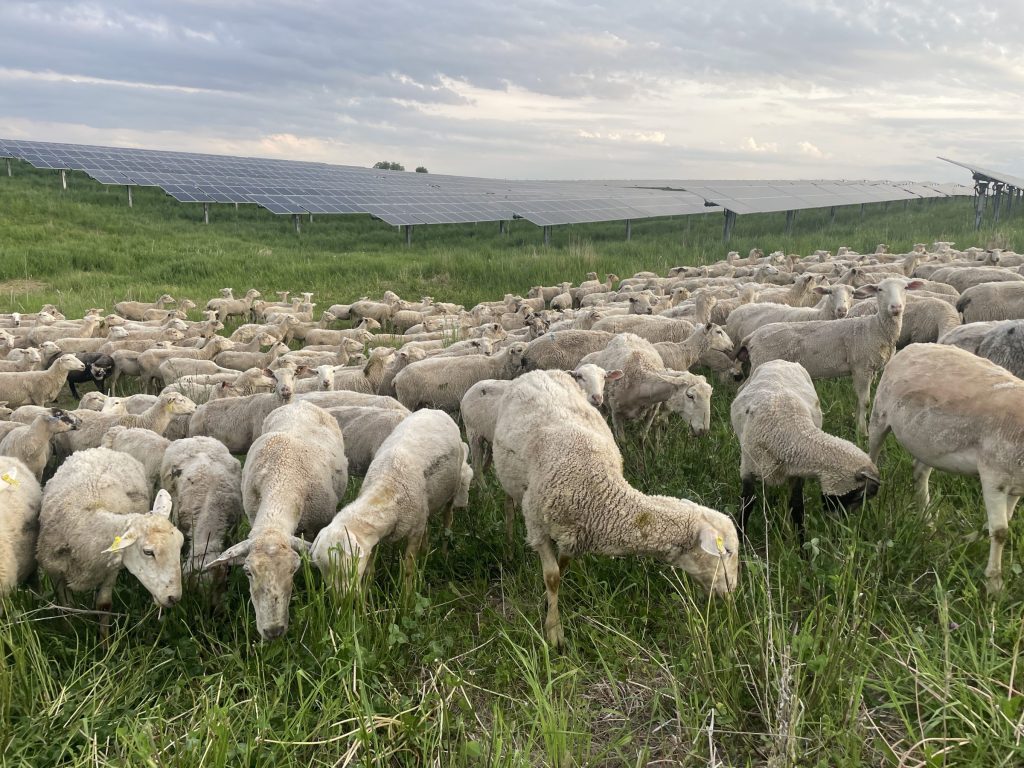
Agrivoltaics projects can include a wide range of crops, from vegetables to grains to livestock. For utility-scale projects it is not currently financially feasible to raise the panels high enough to allow large livestock like cattle easy access under them, or to space them far enough apart to safely allow large farm machinery access. The type of agrivoltaics that has seen the most success to date is sheep grazing.
Wisconsin has several utility-scale solar projects that incorporate sheep grazing. These projects have provided benefits for both solar operators and farmers, though they require coordination and an understanding of both agricultural and energy production needs. Learn more on RESET’s Solar Grazing page and see RESET’s Solar Grazing Checklist for additional guidance.
Currently, allowing cattle to graze in utility-scale solar systems is not economically feasible because of the risk that the animals will damage the panels. Raising the panels high enough that cattle cannot reach them is currently too expensive, and there are concerns that cattle may damage the solar panels. However, there are a few sites where solar developers have raised panels to accommodate cattle, and research on cattle/voltaics is ongoing.
Production of alfalfa and other forages on agrivoltaic sites is likely to be both economically and technically feasible, and would integrate well with the existing dairy sector in Wisconsin. Like sheep grazing, this practice will require planning and accommodation on the part of both solar site operators and farmers, such as use of small equipment.
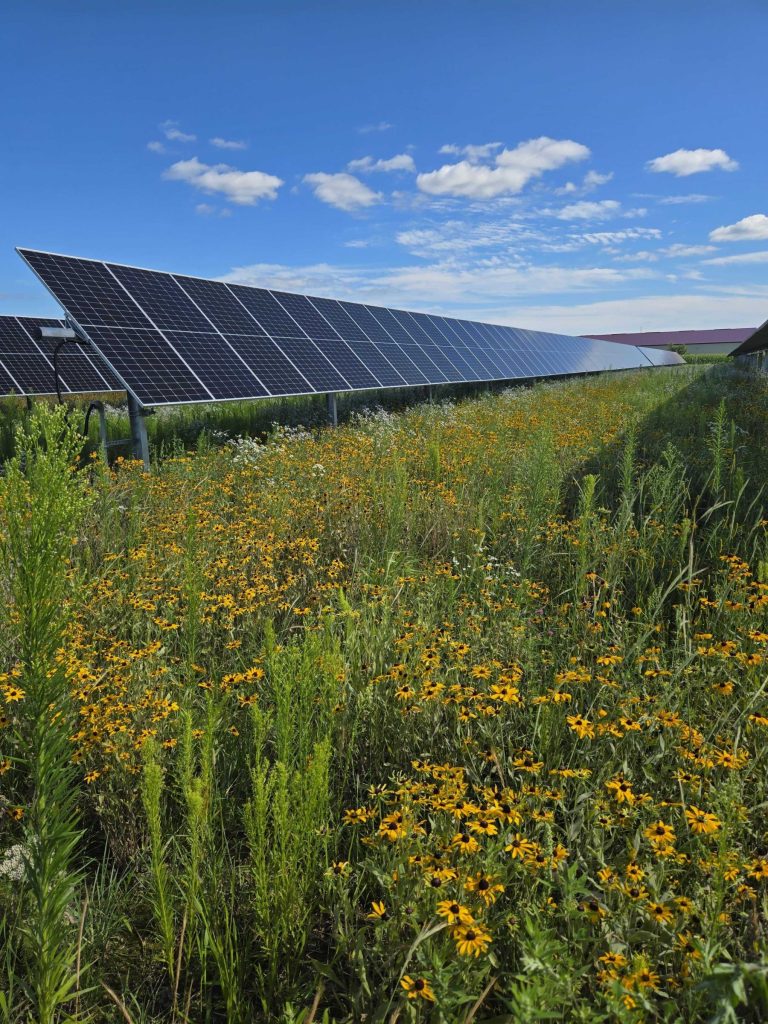
Solar project operators can plant a diverse mix of native grasses and flowering plants to hold the soil in place and provide environmental benefits. While the seed is more expensive and is likely to require more management than turf grass for the first year or two, the additional costs are not prohibitive, and the ecological benefits are significant.
While these plantings are not an agricultural crop, the pollinators and other beneficial insects supported by diverse native vegetation can benefit nearby agricultural crops. Researchers and agencies can use tools such as pollinator scorecards and pollinator counts to track the quality of the habitat over time. This tracking can help communities quantify the responses of native plants and animals when solar panels are introduced to the land, allowing for necessary adjustments
Agrivoltaics Resources
Solar Grazing Checklist
RESET’s key considerations for farmers and solar operators considering agrivoltaics.
Solar Grazing
RESET’s page with more information and FAQ’s on solar grazing.
Sheep + Solar video
Sheep + Solar is an educational video that explains how one Wisconsin farmer has implemented agrivoltaics. It touches on benefits for vegetation management, opportunities for farmers, and considerations for coordinating between solar operators and livestock producers.
AgriSolar Lessons
Wisconsin’s K-12 Energy Education Program (KEEP) provides classroom resources about how land can be used for both agriculture and solar projects.
Agrivoltaics Webinar Series
A webinar provided by University of Minnesota’s Beef and Dairy on cattle agriculture combined with solar projects.
Pollinator Scorecards
This tool by UW-Madison gives familiarity with the features that create a healthy pollinator habitat, an assessment of the quality of pollinator habitat and ways to mitigate activities that are potentially harmful to pollinators, as well as a list of actions to improve the habitat on your site.

RESET: Engaging Wisconsin Communities in Renewable Energy
Contact RESET:
3500 University Avenue, Madison Wisconsin, 53705