There are a number of factors feeding into the current labor shortage, and while the problem seemed to accelerate after the COVID-19 pandemic, we have been facing a downward trend in unemployment for over a decade.
This webinar highlights several rural workforce challenges and the role that university extension can play in addressing these challenges. It also introduces the Future Opportunities for Rural Workforce and Rural Development (FORWARD) curriculum designed by the North Central Regional Center for Rural Development (NCRCRD) at Purdue University and the Association of Public and Land Grant Universities (APLU)—a curriculum intended to support extension professionals in their efforts address some of these rural workforce challenges. The webinar gives particular focus on how labor market information (LMI) and other types of socio-economic data can be more effectively woven into rural workforce planning efforts.
In this webinar, our expert panel discusses clean energy funding available to businesses at both the Federal and state level, how to optimize your access to funding & financing, strategies to lower your tax liability, and programs to increase the clean energy workforce in Wisconsin.
Using the latest research and data specific to Wisconsin’s rural communities and regions, this summit focuses on the Wisconsin rural economy. The summit includes an overview of the latest economic and demographic trends across rural communities, an examination of entrepreneurship, and a discussion of what rural communities can do to foster economic growth and development.
In today’s world, having access to high-speed internet is essential for full participation. This includes how we work, learn, live, access healthcare, and participate in democracy. To ensure prosperity in Wisconsin communities, local and regional partners need to plan for broadband access thoughtfully. In this webinar, we discuss the Broadband Equity, Access, and Deployment (BEAD) program and provide an overview of state-wide broadband planning efforts and funding opportunities for local county and Tribal broadband planning.
One long-held strategy to foster economic growth and development is to recapture tax dollars that flow to higher units of government. Paying taxes to higher units of government, such as the state and/or federal government, is a leakage from the local economy. In a sense, these leakages are akin to a local business buying inputs from vendors outside of the community or local residents shopping outside of the community. While many communities strike to close these leakages by encouraging firms and shoppers to buy locally, such an approach does not apply to state and federal taxes. Rather, communities often strive to have those dollars returned to the community through local state and federal government spending.
People of color are starting and growing businesses at high rates in Wisconsin. This study explored the experiences of BIPOC entrepreneurs in Fond du Lac County through 1-1 interviews and the Community Capitals Framework (CCF). Business owners expressed satisfaction with the natural beauty and safety of the area while describing limited technical knowledge (human capital), networks (social capital), and financial capital in the critical startup phase of their entrepreneurship. Business development technicians and educators can use this study to better support entrepreneurs of color in their Wisconsin communities.
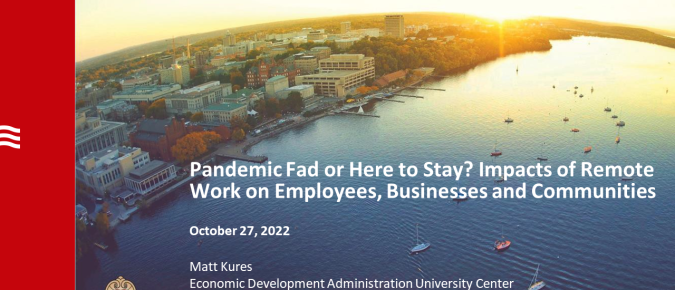
The movement of employees to remote work due to the COVID-19 pandemic has been well-documented. Indeed, the Census Bureau recently reported that the number of people working primarily from home tripled between 2019 and 2021. This shift certainly caused hardship among some employees but was widely embraced by many others. With the World Health Organization noting that the pandemic is nearing its end, employees, businesses and communities face questions regarding the future of remote work. This webinar explores trends in remorse work and offers insights into questions about the future of remote work.
Summary Date: Wednesday, October 12 | Location: Nicolet College Theatre, Lakeside Building. Special Guest: Neel Kashkari, President, Federal Reserve Bank of Minneapolis Sponsors: Grow North, The Lac du Flambeau Band of the Lake Superior Chippewa Indians, Nicolet College, Baylake Regional Planning Commission, North Central Wisconsin Regional Planning Commission, and University of Wisconsin-Madison Division of Extension […]
Over the last couple of decades, community economic development practitioners and researchers have explored the importance of quality of life on economic activity and population growth. Dr. Amanda Weinstein discusses her work on the importance of quality of life for Midwestern communities and shares what this might mean for a broader set of economic development policy recommendations.
Summary June 2022 — Dr. Tessa Conroy discusses entrepreneurial activity in Wisconsin during the COVID-19 pandemic. Entrepreneurship is a key part of any healthy economy but ensuring that new business activity leads to significant economic impact by creating high-quality jobs can be difficult. Learn about entrepreneurial activity in the state and hear discussions on what […]
EXECUTIVE SUMMARY May 2022 — Innovation moves the economy forward. Innovations are new products, processes, or services that create value for customers. Innovations often signal an improvement over a past model or way of doing things. Innovations can be significant, disrupting the status quo. Many innovations, however, are modest, offering small increases in quality of […]