

Home » RESET: Renewable Energy Siting & Engagement for Tomorrow » Environmental Impacts FAQ
Environmental Impacts FAQ
RESET: Engaging Wisconsin Communities in Renewable Energy
Environmental Impacts FAQ
Environmental Impacts FAQ
The greatest potential impacts to soil health from solar projects typically occur during construction and decommissioning, when heavy equipment and soil disturbance can increase soil compaction and erosion. Developers can reduce these impacts by minimizing grading and topsoil movement and following best management practices during construction. See the Wisconsin DNR’s Best Management Practices for Solar Energy Projects for additional ways to minimize soil damage during construction.
Solar projects can affect water resources differently depending on site conditions and management practices. Construction and decommissioning pose the greatest risks due to soil disturbance and compaction, which can increase runoff and erosion. These impacts can be reduced by following best management practices such as the Great Plains Institute’s Photovoltaic Stormwater Management Research and Testing (PV-SMaRT) project. When solar replaces row crops and sites are planted with perennial, deep-rooted vegetation, projects can improve water quality and reduce runoff and erosion.
The impact of solar projects on habitat and wildlife depends on the condition of the land before construction. In previously cultivated areas, habitat can improve if native or pollinator-friendly vegetation is added after construction. Careful siting, permeable fencing, and wildlife corridors can help minimize disruption to wildlife movement. Tools like The Nature Conservancy’s interactive Site Renewables Right map can help identify critical wildlife areas and support informed site planning decisions.
Solar development reduces greenhouse gas emissions and other air pollutants associated with fossil fuel-based electricity generation. Life cycle analyses show that large-scale solar projects produce approximately 90% lower emissions than natural gas, helping reduce climate change impacts.
As discussed in the Life Cycle Analysis section, large-scale wind and solar projects generate 90% lower greenhouse gas emissions than natural gas. Solar panels convert the energy from sunlight into electricity and do not generate waste heat as part of that process, so solar facilities do not have the same heat island effect as urban development. If the sites are vegetated, evapotranspiration (EV) from the vegetation, combined with shading by the panels, may have a slight cooling effect on site during the day. This evaporative cooling will likely be slightly smaller than that associated with corn in July and August. Research at a solar site in Dane County will provide better information on the microclimate impacts of solar facilities in coming years.
Based on a 2024 National Renewable Energy Laboratory report on utility-scale solar projects, the energy payback time (EPBT) of a solar project in Wisconsin would be roughly 0.6 years, and the carbon payback time (CPBT) would be roughly one year. This means that within the first year of operation, a solar panel generates an equal amount of energy as was used to mine materials, manufacture its components, transport it, and install it. After this payback period, all remaining energy generation is effectively net-positive.
When accounting for manufacturing and end of life disposal are included, solar’s total greenhouse gas emissions remain lower than nearly every other energy source, including nuclear and hydropower. During their life cycle, utility-scale solar PV systems in the U.S. generate electricity with 95% fewer greenhouse gas emissions compared to coal and roughly 90% fewer emissions than natural gas. Manufacturing energy use has fallen at least 30% due to efficiency improvements, and solar panels produce 25-35 times more energy than they consume over their lifetimes.
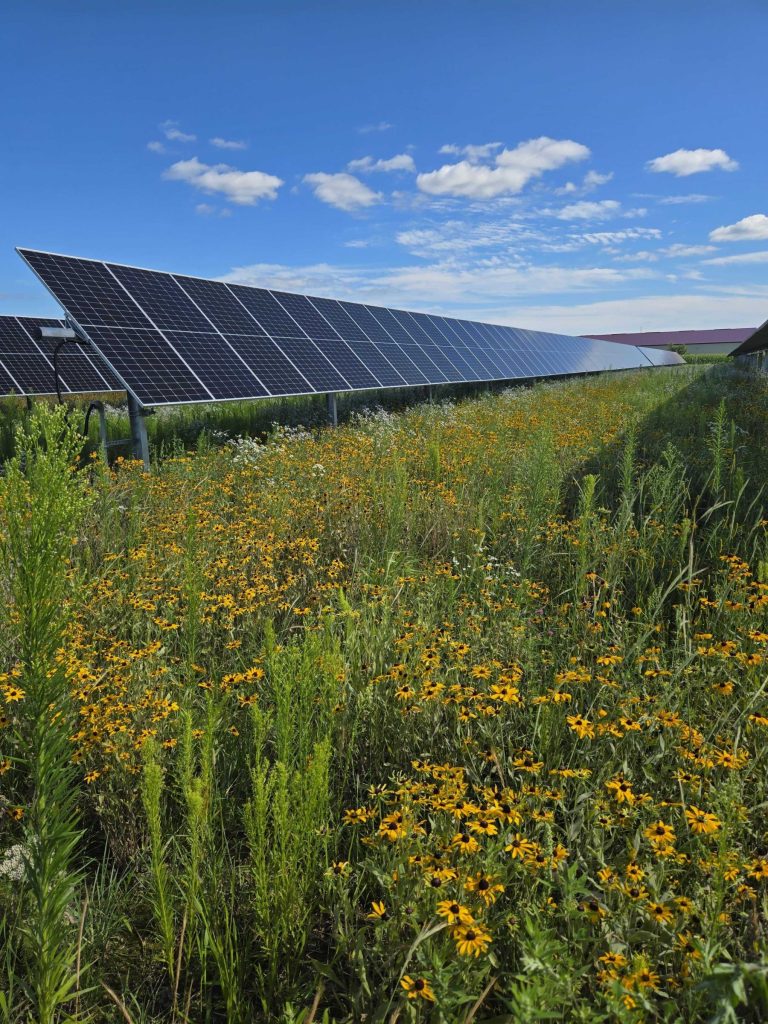
Wisconsin’s native pollinator populations have been declining, and large-scale solar projects offer an opportunity to restore habitat and promote growth by planting native vegetation. Establishing perennial native plants under and between solar panels can improve habitat quality for pollinators in the Midwest by up to 300% compared to traditional row cropland. In addition, when pollinator-friendly vegetation is used, crops such as soybeans and cranberries can see higher yields and improved quality up to one mile beyond the solar site due to increased pollinator activity. When native and pollinator-friendly seed mixes are planted below and between solar panels, they also create stable habitats that support other insects, birds and other small wildlife, especially if mowing or grazing is timed to avoid disturbing nesting birds.

RESET: Engaging Wisconsin Communities in Renewable Energy
Contact RESET:
3500 University Avenue, Madison Wisconsin, 53705