

Home » RESET: Renewable Energy Siting & Engagement for Tomorrow » Land Use FAQ
Land Use FAQ
Land Use FAQ
Large-scale solar projects are most efficient and profitable on large parcels of flat land with deep soils and no trees or buildings, as these sites are easier to connect, more affordable, and ready to build. Because of this, they are often sited on farmland. Although solar projects on buildings, parking lots, and brownfields are all viable and important for energy independence and grid resilience, they are not able to replace utility-scale energy generation facilities on open land.
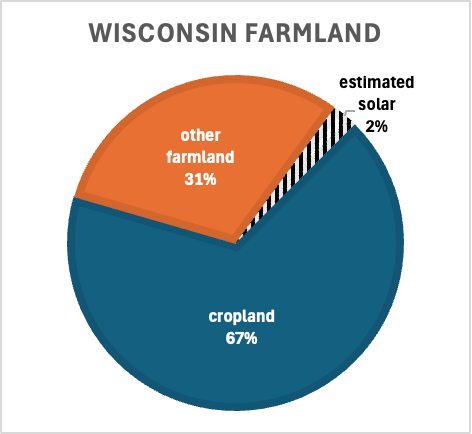
Like any form of development, solar projects may increase the cost of agricultural land nearby. The UW Stevens Point Center for Land Use Education estimated that for Wisconsin to fully meet its renewable energy goals would require roughly 340,000 acres of solar generation which amounts to roughly 3.5% of the cropland in the state, or 2% of the state’s farmland. Further, applications for projects larger than 100 megawatts are required to have plans to minimize the impact on the long-term agricultural potential of the site, including practices to minimize damage to soils and tile drainage and plans to restore the site.
What are the opportunities for Dual-use solar?
Solar project land can support additional uses alongside energy production. This is called dual use, and when combined with agriculture, it is known as agrivoltaics. You can find more information on RESET’s Agrivoltaics page. Further, the Solar Grazing Checklist created by RESET provides guidance for farmers and solar site managers interested in grazing sheep at solar sites.
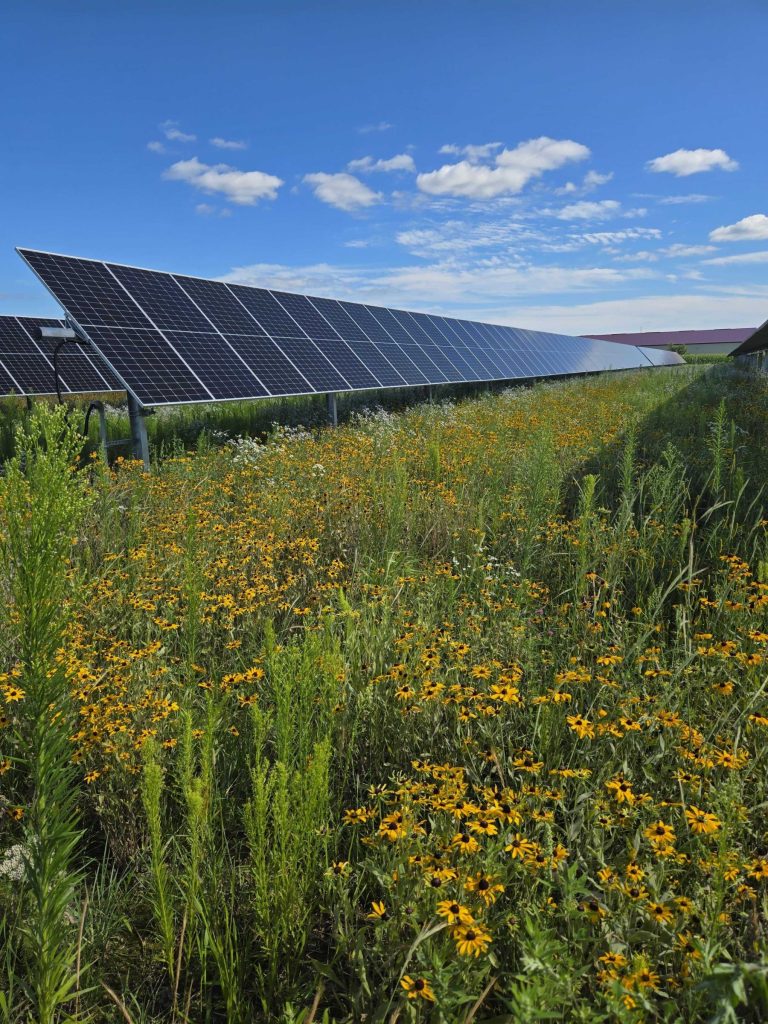
Projects can host diverse native plants to support pollinators and other beneficial wildlife. Many solar project operators plant a diverse mix of native grasses and flowering plants to hold the soil in place and provide environmental benefits. The University of Illinois-Chicago provides a Pollinator Planting Implementation Manual and other Toolkits for more information.
Some crops and livestock can be integrated with solar panels. The most common and successful example is sheep grazing. Sheep keep vegetation low, protect soil, and provide income to farmers, while panels offer shade and existing fencing helps with containment and predator control.
There are ways to reduce changes to the viewshed so that large-scale solar development does not harm the communities scenic beauty or tourism revenue. Developers can plant trees and shrubs around solar projects to reduce visibility of the project from neighboring properties. Other practices that can improve the aesthetics of solar facilities include planting the site with native flowering plants and sheep grazing.
Utility-scale renewable energy projects are mostly built on farmland because it offers large parcels that are easy to connect, affordable, and ready to build.
Solar projects on buildings, parking lots, and brownfields are all viable and important for energy independence and grid resilience. However they are not able to replace utility-scale energy generation facilities because of the acreage required to generate the energy needed. Some limitations to the alternative sites are outlined below.
Buildings
Rooftop solar is an important component of sustainable electricity production, and can provide cost savings as well as environmental benefits. However, in most cases rooftop solar produces just enough electricity to meet the building’s own needs, not large amounts for the wider grid. Commercial rooftop solar is usually tied to a customer’s utility meter and managed through net‑metering programs. Net metering policies vary by utility, and you can learn more about net metering in Wisconsin on the Public Service Commission of Wisconsin’s website.
Parking lots
Solar panels in parking lots are called solar car parks, and they create dual use opportunities for parking lots. There are benefits to the shade from sun or shielding from snow provided by the panels, as well as an opportunity to locate generation closer to demand and EV charging infrastructure. However, they are significantly more expensive than both rooftop and ground‑mounted systems because they require extensive steel structures to elevate and support panels, concrete foundations, additional safety features for vehicle traffic, and considerations for snow loads, plowing, and maintenance. These added costs make solar car parks one of the most expensive forms of solar per kilowatt installed.
Brownfields and degraded lands
Solar on degraded lands such as closed landfills, mines, or brownfields can provide an opportunity to generate power and economic benefit from a site that is not suited for other types of land use. New York and other states have successfully developed 1-5 MW projects on degraded land, but very few exceed this size, in part because most brownfields do not occupy much acreage. In addition, these sites often require special engineering, such as ballasted racking or protective soil caps, which increases costs. Developers may also face additional permitting and environmental regulations, and these projects often need incentives or financial support to be economically viable.
While these sites are valuable for community‑scale solar projects, they cannot replace the land area required for utility‑scale generation.
Wetlands
So much wetland has already been converted to agricultural and other uses that wetland is generally considered a protected habitat type, and additional DNR permits are required for building in wetlands or waterways. Wetlands are generally not preferred for solar projects because the soil disturbance from installing the project in a wetland setting is likely to be particularly damaging to soil and water quality. In addition, construction and vegetation management are likely to be more expensive in a wetland setting.

RESET: Engaging Wisconsin Communities in Renewable Energy
Contact RESET:
3500 University Avenue, Madison Wisconsin, 53705